Pay-As-You-Go AI Image Generation: When Credits Beat a Subscription
A practical guide to choosing pay-as-you-go AI image generation, understanding credits, estimating real project cost, and knowing when an API or subscription is better.

Pay-as-you-go AI image generation is usually the better fit when your work is irregular, you want access to several model families, or you dislike paying during months when you create nothing.
A subscription is often better for predictable, high-volume use. A direct API can be better when you are building software or automating thousands of requests.
The important question is not which billing label sounds cheaper. It is how much a completed, usable image costs in your real workflow.
The quick answer
Choose pay-as-you-go credits when:
- You create in bursts rather than every day.
- You want one balance across different models and tools.
- You do not want automatic renewal.
- You want the price shown before each generation.
- Purchased balance does not expire.
Choose a subscription when you consistently use most of its monthly allowance. Choose a direct API when you need automation, code-level control, or product integration.
Nenis uses one-time credit packs. There is no free tier, subscription, automatic renewal, or advertising. Purchased credits do not expire, and the Create workspace shows the exact credit cost before an action runs.
Compare the real unit of work
“One image” is rarely a useful cost measure by itself.
A project may include:
- Several cheap drafts.
- One reference-led revision.
- A controlled edit.
- One high-quality final output.
- Optional upscaling or background removal.
The real unit is the accepted final asset, including failed directions and revisions.
If a low-cost model needs eight attempts while a stronger model succeeds in two, the stronger model can be cheaper for that task.
How the Nenis credit workflow works
- Buy a credit pack through a one-time checkout.
- Choose a model, quality, number of outputs, and optional features.
- Review the exact credit total before creating.
- Spend the same balance across GPT Image, Nano Banana, Seedream, templates, upscaling, and background removal.
- Leave unused credits in the account until the next project.
Prices differ because providers charge differently and high-resolution or high-quality outputs can require more computation. Nenis translates those differences into whole credits and displays the total before submission.
Pay as you go versus a subscription
| Question | Pay-as-you-go credits | Monthly subscription |
|---|---|---|
| Do you pay in inactive months? | No new charge unless you buy more | Usually yes |
| Does allowance reset? | Depends on provider; Nenis credits do not expire | Commonly resets monthly |
| Is spending predictable per action? | Yes when the price is shown first | Often expressed through plan limits |
| Is high-volume use economical? | Sometimes | Often, if allowance is fully used |
| Is there automatic renewal? | Not in Nenis | Usually |
| Can one balance cover several model families? | Yes in a multi-model studio | Depends on the service |
Pay as you go is not automatically cheaper. It removes the obligation to keep paying when usage stops.
Pay as you go versus direct APIs
Official APIs also bill by usage, but they solve a different problem.
An API normally expects you to manage credentials, requests, model parameters, errors, generated files, moderation behavior, and any interface your team needs. That is valuable when AI image generation is part of a product or automated pipeline.
A creative studio provides the interface, model catalogue, upload flow, output gallery, guided templates, and visible price calculation. The additional service is convenience and workflow, not cheaper raw inference.
For a detailed comparison, read Nenis vs direct AI image APIs.
Estimate a project before you start
Use a small budget plan instead of generating until the balance disappears.
| Stage | Suggested approach |
|---|---|
| Direction | 2–4 low-cost drafts |
| Selection | Pick one direction before changing details |
| Refinement | 1–2 controlled edits |
| Final | One high-quality output at the required size |
| Utility | Upscale or remove the background only if needed |
If the first four drafts all fail for the same reason, stop. Rewrite the instruction, improve the reference image, or choose a model better suited to the constraint.
Questions to ask any credit-based service
- Do purchased credits expire?
- Does buying credits start a subscription?
- Is the cost visible before generation?
- Can prices change with quality, resolution, references, or output count?
- Are failed requests refunded?
- Which models and tools share the balance?
- Can outputs be downloaded at full resolution?
- What happens to uploaded and generated images?
A clear billing model should answer these without hiding the unit conversion.
When Nenis is a good fit
Nenis is designed for a creator who wants to open one studio, choose among current image models, see the cost, and make the asset without configuring provider accounts or code.
It is not the best choice for every situation. Use a direct API when you are building a product, require custom automation, or need provider-level infrastructure controls. Use a subscription when your stable monthly volume makes its allowance more economical.
The recommendation
Use pay as you go when your creative schedule is uneven and control over recurring spend matters more than maximizing a monthly quota.
Start each project with a small draft budget, choose the final model intentionally, and compare the cost of an accepted result—not the advertised cost of one attempt.
Sources and image credits
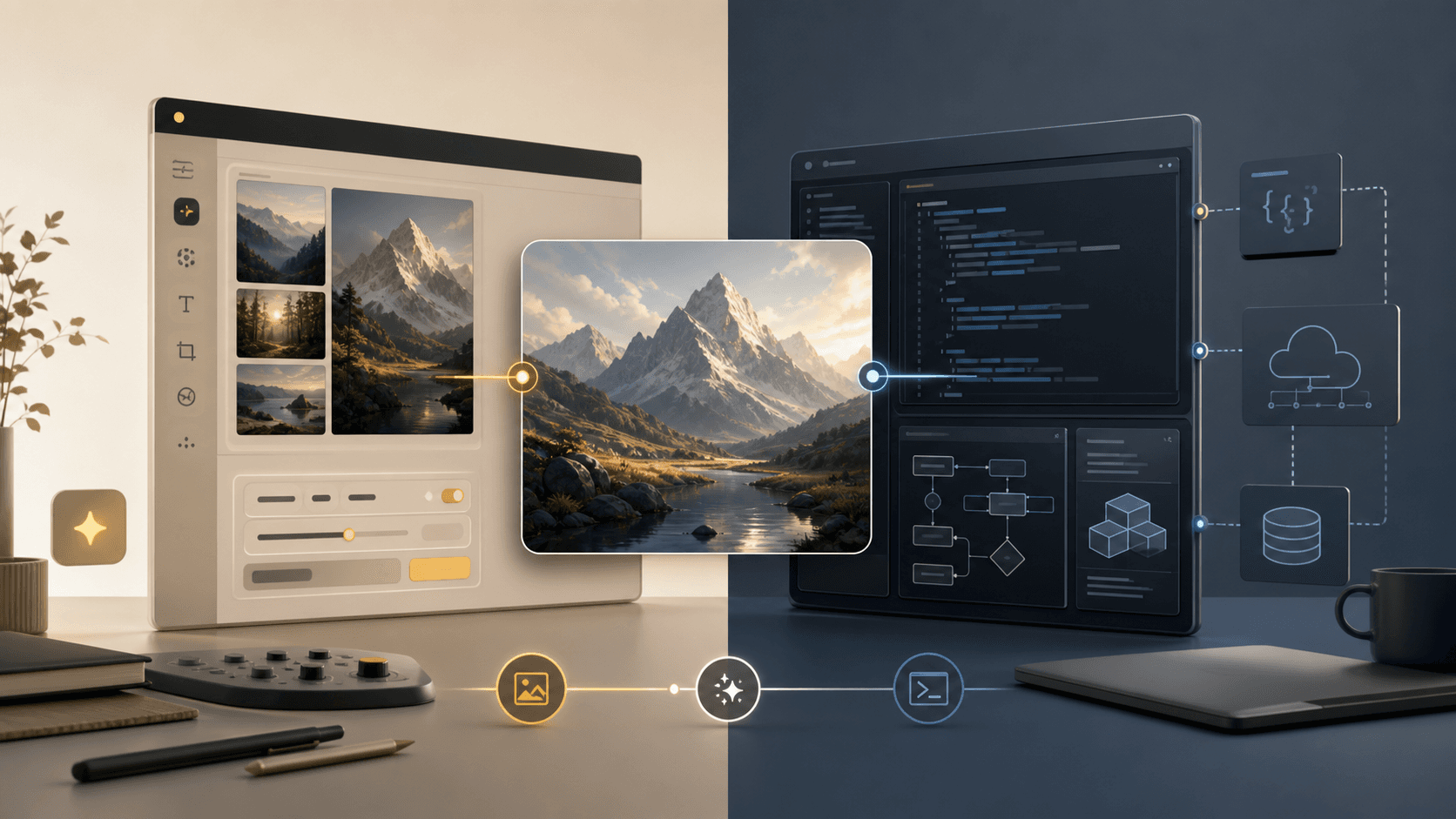
Nenis billing behavior is based on the current Nenis credit interface and FAQ: one-time credit packs, no automatic renewal, visible pricing before each action, and credits that do not expire. Current packs and action costs are shown inside Nenis. The hero image was generated for this Nenis Journal article with no third-party brands or interfaces.